Why Is Ethereum Going Down? 5 Reasons ETH Is Falling in 2026
The short answer
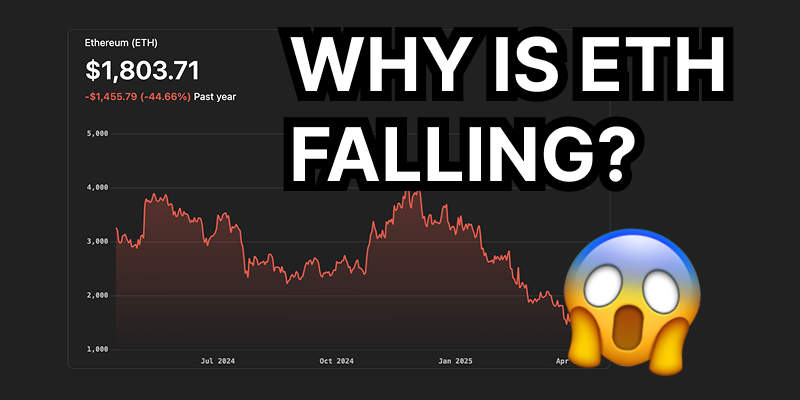
Ethereum is going down because money is leaving it faster than it's coming in. As of June 8, 2026, ETH trades around $1,660, roughly 66% below its August 2025 record of $4,954. The biggest single cause is record outflows from the spot Ethereum ETFs, which just posted their worst month since launch and a record 17-day selling streak. Add a risk-off market, weak network fundamentals, and a token that keeps losing ground to Bitcoin, and you get the chart you're staring at. Below is each reason in plain terms, plus the recovery case and the bigger argument driving all of it.

Where ETH stands right now (June 2026)
- Price: about $1,660 (June 8, 2026), give or take depending on the exchange
- Down about 27% over the last 30 days
- Down about 66% from the all-time high of $4,954 (August 24, 2025)
- ETH/BTC ratio near 0.027, around its weakest in a year, which means ETH is losing value against Bitcoin, not just against the dollar
This is not one of those weeks where all of crypto fell together. In 2026, ETH has dropped harder than most large-cap coins, and that gap is the real story.

1. The Ethereum ETFs are bleeding money
This is the main driver. When the U.S. spot Ethereum ETFs launched, they were meant to be a steady new source of demand: pensions, advisors, and institutions buying ETH through an ordinary brokerage account.
In 2026 that demand went into reverse. May alone saw about $401 million walk out the door, the worst month since the funds opened, and the withdrawals then ran for a record 17 trading days in a row into early June. April had briefly swung back to inflows, but the selling returned fast. Stretching back to when the trend began in late 2025, the funds have shed well over $2 billion.
Here is why that moves the price. Every dollar pulled from an ETF is ETH the fund has to sell on the market. Steady selling with no one stepping in to buy is, mechanically, why the price keeps grinding down.
2. ETH is falling harder than Bitcoin
When the mood turns cautious, traders dump their riskiest holdings first. ETH is the higher-volatility bet next to Bitcoin, so it takes the bigger hit.
The numbers back it up. So far in 2026, ETH is down roughly 32% while Bitcoin is down closer to 11%. The ETH/BTC ratio sits near 0.027, around its lowest in a year. Part of the reason is structural: Bitcoin has big corporate treasuries quietly buying and holding, and ETH has no buyer of that size soaking up supply. So when fresh money does come into crypto, more of it lands on Bitcoin first.
3. The "ultrasound money" story broke
For a few years, Ethereum's pitch to investors was simple: it was deflationary. The network burned more ETH in fees than it created, so the supply slowly shrank. That idea, nicknamed "ultrasound money," gave people a clean reason to hold the token.
In 2026 it stopped being true. After the Dencun upgrade moved most activity onto Layer 2 networks (cheaper chains that settle on top of Ethereum), the fees that used to be burned on the main chain dried up. ETH supply is now slightly inflationary again. The scarcity story that propped up the price is, for the moment, gone.
4. Macro pressure and forced selling
Ethereum does not trade in its own little world. Through 2026, sticky inflation, tariff uncertainty, and interest rates staying higher for longer have pushed investors out of speculative bets across the board. ETH tends to move with tech stocks (its correlation to the Nasdaq has run around 0.78), so when the stock market wobbles, ETH usually slides with it.
Borrowed money makes the drops sharper. A lot of ETH is bought on leverage. When the price slips below a level where those traders are forced out, their positions get liquidated, meaning automatically sold, which knocks the price down again and triggers the next wave. That is why ETH tends to fall in fast steps instead of a gentle drift.
5. Competition is eating Ethereum's activity
Ethereum is still the largest smart-contract network, but it is no longer the only room where things happen. Solana has been pulling a growing share of on-chain trading, with weekly volume on its exchanges repeatedly beating Ethereum's main chain in 2026. Newer venues like Hyperliquid are taking traders too.
Less activity on Ethereum's base layer means fewer fees, less burn (back to reason 3), and a weaker "this is where the action is" story. All of that feeds back into the price.
The bigger debate: is ETH broken, or just cheap?
Underneath the ETF flows and the macro noise sits the question the whole market is arguing about right now: does ETH the token actually capture the value of Ethereum the network?
In late May 2026, Ryan Sean Adams, co-founder of Bankless and one of Ethereum's most committed bulls, lost patience with the "bullish on Ethereum, bearish on ETH" crowd. His line: "There is no strong Ethereum without an ETH worth trillions." He sees the token doing three jobs at once, as money, as collateral, and as the "economic bandwidth" that DeFi runs on. If people can use Ethereum while ignoring ETH, he argues, then "Ethereum is a failed project. Full stop."
The disagreement is just as loud, and it comes from inside the house. Adams' own Bankless co-founder, David Hoffman, sold the last of his ETH around the same time. His view: nobody has shown a durable mechanism that ties the network's growth to the token's price, and most of the upside flows to the apps built on top rather than to ETH itself.
That split is a big part of why ETH is falling harder than its fundamentals alone would explain. When the people closest to Ethereum cannot agree that owning ETH is the way to bet on it, larger buyers hesitate, and a hesitant market sells. "Ultrasound money" used to be the easy answer to "why hold ETH." With that answer on pause, the market is openly re-litigating the case for the asset, and you can read the verdict in the chart.
What about the staking ETF that was supposed to save ETH?
Fair question, and it is the one most price articles get wrong. BlackRock's staked-Ethereum ETF (ETHB) actually launched in March 2026. It is a real, approved product that passes staking rewards through to holders, and a lot of people expected it to bring in fresh demand.
It has not turned the price around. ETH kept falling through spring and into June even with the staked ETF live. The takeaway: a shiny new product cannot outrun billions of dollars leaving the funds that already exist. So if you see "the staking ETF will fix everything" takes, that catalyst already came and went.
Will Ethereum recover? The case for a bounce
A red chart is not the whole picture. There are real arguments for a recovery, and any honest answer has to include them:
- The selling looks stretched. Momentum gauges like RSI have been sitting in oversold territory (readings near 30), which has lined up with short-term bottoms more often than not.
- Big holders are buying the dip. On-chain data shows large wallets adding ETH even while the price falls.
- The tech keeps shipping. The Fusaka upgrade (live December 2025) cut Layer 2 costs again, and cheaper, faster L2s are how Ethereum stays competitive over the long run.
- Analysts still see higher prices eventually. Standard Chartered trimmed its 2026 target but kept it well above today's price (about $4,000, down from $7,500). Citi sits near $3,175. Bearish calls cluster around $1,400 to $1,500; bullish ones run $6,200 to $7,500. These are forecasts, not promises, so treat them as a spread of opinions rather than a number to bank on.
None of this proves the bottom is in. It just means the bear case (outflows, macro, weak fundamentals) and the bull case (oversold, accumulation, upgrades) are both live right now.
What a falling ETH price means for Web3 jobs
If you work in Web3, or you are trying to break in, here is the part that actually touches your life: price and hiring are connected, but they do not run on the same clock.
- Hiring lags the price, in both directions. Teams that raised money in the last bull run are still building and still hiring through the dip. A red week does not mean the job market froze that week.
- Down markets reward people who build. Some of the strongest Web3 hiring happens in quiet stretches, when serious teams keep shipping and the tourists go home. Skills get you hired, not the token price.
- Ethereum is still the deepest pool of jobs in the space. Solidity, smart-contract, and Layer 2 roles remain the biggest slice of the market no matter where ETH trades this month.
So if you landed here because the chart is red, the price is the noise. Whether you can build is the signal. Have a look at open Ethereum jobs, Solidity jobs, and remote Web3 roles to see who is hiring today.
Frequently asked questions
Why is Ethereum going down right now?
Mostly because money keeps leaving the spot Ethereum ETFs (May 2026 was their worst month since launch, followed by a record 17-day outflow streak), on top of a cautious market, weak network fundamentals, and ETH underperforming Bitcoin. There is no single trigger; it is several pressures stacking up at once.
Is Ethereum dead?
No. Ethereum is still the biggest smart-contract network by developers, value secured, and ecosystem size. A low price reflects market conditions and capital flows, not the network shutting down. People have called Ethereum dead in every downturn since 2018 and have been wrong each time.
Will Ethereum recover in 2026?
Maybe, but nobody knows. The bull case (oversold momentum, large holders accumulating, cheaper L2s after Fusaka) is real, and so is the bear case (ETF outflows and macro pressure). Analyst targets for 2026 run from about $1,400 at the low end to past $6,000 at the high end. Treat all of them as opinions, not facts.
Why is ETH dropping harder than Bitcoin?
ETH is the higher-risk, higher-volatility asset of the two, so it sells off faster when the market gets nervous. Bitcoin also has large corporate treasuries buying and holding supply that Ethereum lacks. The ETH/BTC ratio near 0.027 shows the gap directly.
Has Ethereum bottomed?
Unknown. RSI suggests the recent selling is stretched, and analysts point to support around $1,400 to $1,500. But oversold can stay oversold, and a bottom is only obvious in hindsight.
Why is Vitalik Buterin selling ETH?
Vitalik and the Ethereum Foundation sold roughly 17,000 ETH in 2026, mostly to fund operations and grants, which is fairly routine treasury management rather than a sign insiders are bailing. The Foundation said in May 2026 it plans to sell less going forward. The amounts are small next to daily trading volume; the bigger effect is on sentiment.
Should I buy Ethereum while it is down?
This article does not give financial advice. What is true: ETH is far below its 2025 high, momentum is oversold, and most analysts still see a constructive long-term picture. It is also true that crypto is volatile and can fall further. Do your own research and only risk what you can afford to lose.
Bottom line
Ethereum is going down in 2026 because demand dried up faster than supply. The ETFs turned into net sellers, the wider market is punishing risky assets, the deflation story broke, and ETH is losing ground to both Bitcoin and faster rivals. Underneath all of it is a genuine argument about whether ETH the token even captures Ethereum's success. The recovery case exists, from oversold momentum to steady accumulation to cheaper Layer 2s, but it has not taken hold yet.
And if you are here because the chart is red and you work in Web3, or want to, keep the two clocks separate. Builders still get hired in down markets.
Ready to find a role? Browse Ethereum jobs and remote Web3 jobs on web3.career. 73,000+ listings, zero noise.
This article is for information only and is not financial advice. Crypto prices are volatile; figures are accurate as of June 8, 2026.
Want to find a web3 job?
| Job Position and Company | Location | Tags | Posted | Apply |
|---|---|---|---|---|
| | Remote | |||
| | Remote | |||
| New York, United States | ||||
 | by Metana | Info | ||
| United States | ||||
| | Jersey City, NJ, United States | |||
| | United States | |||
| | New York, United States | |||
| | New York, United States | |||
| | New York, United States | |||
| | New York, United States |